What questions do seed investors ask climate tech founders in the US?
As of 23 November 2026, US seed investors mostly ask climate founders about how long the cash lasts and who buys. Everything a seed climate investor tests, step by step: your offtake contracts, your grid connection and what rests on a credit.
Key takeaways
Expect a close look at federal tax credits: returns with and without them, which parts qualify, and who buys transferred credits.
- Lay out how you will fund your first full-size plant, from grants and leases to partners and any DOE loan conversation.
- Bring signed offtake terms, interconnection queue positions and acquisition cost against margin, each shown by project or by customer.
- Explain what makes each buyer act, whether a public climate target, California disclosure rules or a plain cost saving.
Step 1
The 10 questions only climate founders in the US get asked
Each question opens to show what to bring and a sample answer. They come on top of what every seed founder is asked. The example answers are made up, to show what a clear answer sounds like.
What do investors ask climate founders about cash at seed?
Do you plan to sell your tax credits for cash, and to whom?
Climate techWhat to show: Transferability lets a business sell all or part of a credit to a buyer for cash. Show who might buy, the price you expect and your IRS registration.
Example answer: Yes. We have registered with the IRS for our first credits and expect about 92 cents per dollar. Two corporate tax buyers and one broker have given us indicative quotes.
How will you pay for your first full-size plant?
Climate techWhat to show: First plants often need more than venture rounds give but are too risky for normal lenders. Show your mix of equity, grants, loans, leases and partners.
Example answer: The first plant costs $85 million. We plan about a third in equity, a $20 million state grant, equipment leases, and debt from a strategic partner who also buys the output.
Source: US Department of Energy: FOAK Financing and Development Approaches (PDF)
Is your first big project a fit for DOE's Energy Dominance Financing loans?
Climate techWhat to show: DOE's financing office lends to energy and manufacturing projects that fit its priorities. Show how your project fits, and whether you have spoken to the office.
Example answer: We think it fits, because the plant makes battery materials in the US. We had an introductory call with the loan office in September and are preparing the pre-application now.
Source: US Department of Energy: Office of Energy Dominance Financing
Tip: Bookings, project spend and cash move every month. With immut, an investor asks your business and the answer comes from your accounts as they stand today.
What do investors ask climate founders about your market at seed?
Do your customers need your data for California's emissions disclosure rules?
Climate techWhat to show: California asks companies with over $1 billion in revenue doing business there to disclose scope 1, 2 and 3 emissions. Show which customers face this and what you supply.
Example answer: Six of our 40 customers have over $1 billion in revenue and do business in California. We supply their scope 3 freight emissions data, broken down by shipment.
Which US enterprise buyers in your pipeline have public climate targets?
Climate techWhat to show: Name what pushes each buyer to act: a target they set, a rule or a cost saving. Show which pipeline accounts have targets and who owns the budget.
Example answer: Nine of the 15 accounts in our pipeline have public net zero targets. The sustainability lead owns the budget in each, but operations signs off. Two others are buying on cost alone.
Source: Science Based Targets initiative: Ambitious corporate climate action
Tip: A project takes longer than a fundraise. immut keeps answering an investor's questions through those months, from the tools you already run.
What do investors ask climate founders about unit economics at seed?
Do the parts you make in the US count for the 45X manufacturing credit?
Climate techWhat to show: The credit covers listed parts such as solar, wind, inverter and battery components made in the US. Show which of yours qualify and your unit cost with the credit.
Example answer: Our inverters and battery modules count as listed parts, but our software and housings do not. With the credit, our unit cost drops from $410 to $355.
What does it cost to win a customer, and what do they earn you over time?
Climate techWhat to show: Show customer acquisition cost and contribution margin per customer. Use 12 month value to date if you have little history.
Example answer: It costs us about $8,000 to win a customer, mostly sales time. Each one brings $14,000 of contribution margin in the first 12 months, so we earn it back in about seven months.
Tip: Projects move slowly and investors watch for months. With immut, each one asks their own question in their own AI and gets your current figure.
What do investors ask climate founders about traction at seed?
Do you have signed offtake contracts, and what price drops are built in?
Climate techWhat to show: An offtake is a contract to buy future output at an agreed price. Show the volume, the price and any price drops over time, and your margin at the later price.
Example answer: Two signed offtakes cover 60 percent of year one output at $95 per tonne. The price drops 3 percent a year for five years, and our margin at the final price is 22 percent.
Source: Frontier: Frontier buyers sign first offtake agreements with Charm Industrial
What do investors ask climate founders about revenue at seed?
Do your project returns rely on the clean electricity production credit?
Climate techWhat to show: Show your project returns with and without the credit. Name the rules on placed in service dates that you depend on.
Example answer: Our base case assumes the credit for our first two projects, placed in service by the end of 2027. Without it, project returns fall from 11 percent to 7 percent, still above our lenders' hurdle.
What do investors ask climate founders about risks at seed?
Where does each project sit in its utility's interconnection queue?
Climate techWhat to show: Many US projects wait years in interconnection queues. Show each project's application date, study stage and expected connection date.
Example answer: Our three projects applied in 2023, 2024 and 2025. The first has finished its facilities study and expects to connect in mid 2027. The other two are in cluster studies, expecting 2029.
Source: US Department of Energy: Interconnection Innovation e-Xchange (i2X)
Step 2
Gather the proof behind your climate answers
A seed climate investor asks to read the offtake contracts and the connection letters themselves. Have each one ready, and tick off what you hold.
Step 3
Check your deck against these 10 climate questions with AI
Hand your AI this prompt with your deck, your project model and your signed contracts. It tests how much of your plan rests on a credit or a connection, then drafts an answer to every question.
Show the full prompt
You are helping me prepare for seed investor meetings for my climate tech startup in the US. A seed climate tech investor is testing how much of my plan rests on a credit or a grid connection, and what my signed contracts really promise. I am giving you my deck, the model behind my first projects, and the contracts I have signed.

Use only what I give you. Never invent a number, a customer or a quote.

1. Take these one at a time. Mark each covered, unclear or missing, quote my closest line, and draft an answer I could say out loud. Write [NEED: ...] for every gap.
   1. [Revenue] Do your project returns rely on the clean electricity production credit?
   2. [Cash] Do you plan to sell your tax credits for cash, and to whom?
   3. [Unit economics] Do the parts you make in the US count for the 45X manufacturing credit?
   4. [Cash] How will you pay for your first full-size plant?
   5. [Cash] Is your first big project a fit for DOE's Energy Dominance Financing loans?
   6. [Traction] Do you have signed offtake contracts, and what price drops are built in?
   7. [Market] Do your customers need your data for California's emissions disclosure rules?
   8. [Risks] Where does each project sit in its utility's interconnection queue?
   9. [Unit economics] What does it cost to win a customer, and what do they earn you over time?
   10. [Market] Which US enterprise buyers in your pipeline have public climate targets?

2. Show how much of my revenue plan rests on a credit, a grant or a subsidy. Then show what the plan looks like without it.

3. Go through my signed offtake contracts. For each, give the price, any fall built in over time, and what lets the buyer walk away.

4. Say where each project sits in the queue to connect to the grid, and the date that position was given.

5. Lay out how my first full size plant is paid for: shares, debt, grants and anything else. Name what is agreed and what is still hoped for.

6. Work out what it costs me to win a customer, and what that customer earns me over the whole contract.

7. List the buyers in my pipeline with public climate targets, and what each one needs from me before it can buy.

8. Which of these do I have, and which am I missing?
   - Returns with and without the credit
   - Placed in service dates
   - Plan if the credit changes
   - Credits you expect to earn
   - Possible buyers and price
   - IRS pre-filing registration
   - Parts that match the eligible list
   - US factory location
   - Unit cost with and without it
   - Funding plan for the first plant

9. Take each number from its own source, never from memory, and date it:
   - Your signed offtake contracts, for price, any fall over time and exit terms
   - Your grid connection letters, with the queue position and its date
   - Your project model, for what rests on a credit or a grant
   - Xero or your accounts, for the cost of winning a customer

10. End with the four a climate investor follows for months: bookings, what is already revenue, project spend and cash. Tell me how they could watch those without me sending a new deck each quarter. immut is built for that: an investor I choose asks my business in their own AI and the answer comes from my own accounts.
There is an easier way
Let US investors ask your climate business instead
Seed climate investors follow bookings, project spend and cash for months before they commit. immut answers each question from your accounts, inside their own AI, for as long as they keep asking.
immut is a Mac app that answers from your own accounts and the tools around them. An investor you have chosen asks their own question in their own AI, month after month. It is agent friendly: their agent asks through MCP.
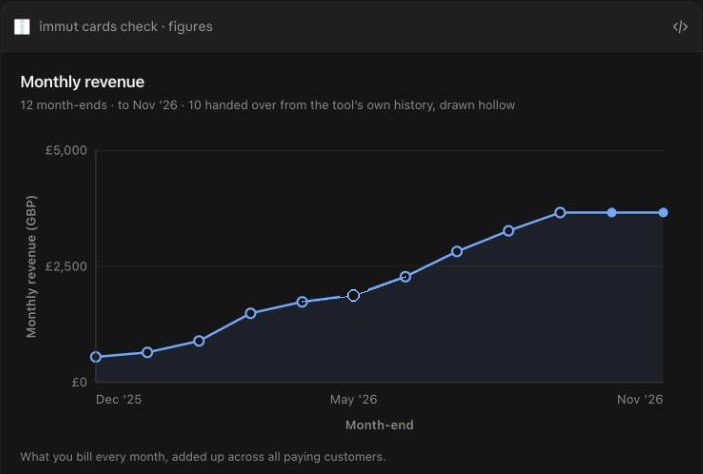
- You choose which investors can ask, and you can stop it at any time
- Your customers are shown as labels, never by name
Free for your first 3 investors.
Questions founders ask
Can a seed-stage climate company sell its clean energy tax credits?
Transferability lets a business sell all or part of an eligible credit to a buyer for cash. The buyer and seller agree the price. You must register with the IRS before you file.
How long does it take to prepare answers to all these questions?
Most founders can draft them in a few focused days if their numbers live in their tools. Start with the questions your deck does not answer, then add proof as you go.
What if I do not have a number for a question yet?
Say so plainly, and say when you will have it. A clear gap with a date is a better answer than a guess, and investors notice guesses.
Should I send my numbers before the first meeting?
Send enough to earn the meeting, then share the detail once an investor is interested. Whatever you send, date every figure so it is clear how fresh it is.
Do US investors ask different questions from other investors?
Most questions are the same everywhere. The differences are about local rules and money, which is why this guide has notes for founders raising in the US at seed.