What questions do seed investors ask B2B SaaS founders in the US?
As of 21 November 2026, US seed investors mostly ask B2B SaaS founders about who uses it, the team and the risks. Everything a seed B2B SaaS investor tests, step by step: how much revenue repeats, how long a deal takes, and burn.
Key takeaways
Buyers and investors will ask about SOC 2, FedRAMP and California privacy requests, so know where you stand on each.
- Know which securities exemption the round uses, and be able to show whether every investor is accredited.
- Be ready to show net revenue retention, burn for each dollar of new recurring revenue, and bookings kept apart from revenue.
- Expect questions on who holds the budget, how long deals take, and whether anyone besides the founders can close.
Step 1
The 10 questions only B2B SaaS founders in the US get asked
Each question opens to show what to bring and a sample answer. They come on top of what every seed founder is asked. The example answers are made up, to show what a clear answer sounds like.
What do investors ask B2B SaaS founders about traction at seed?
Do customers spend more with you each year than when they first signed?
B2B SaaSWhat to show: Show net revenue retention: what a group of customers pays now against a year ago. Include upgrades, downgrades and losses. Above where they started means the product is spreading.
Example answer: Yes. Customers who signed a year ago now pay 118% of what they paid then. Upgrades added more than the downgrades and losses took away.
Source: First Round Review: Net Revenue Retention (NRR), definition and strategies
Who signs off on the budget, and how long from first call to signed contract?
B2B SaaSWhat to show: Name the job title that holds the budget. Show the days from first call to signature, by deal size. Bigger firms take longer, so show how the round funds that wait.
Example answer: The VP of Finance holds the budget in almost every deal. Deals under $20,000 a year take about 35 days, and larger ones around 90. This round covers that longer wait.
Source: Bessemer Venture Partners: Moving upmarket and the ascent of SMB SaaS
Tip: Retention, burn and pipeline all move every month. immut answers each of them from the tools running your company, inside whichever AI the investor uses.
What do investors ask B2B SaaS founders about the team at seed?
If key hires come from outside the US, how will they get the right to work here?
B2B SaaSWhat to show: Name the roles in your hiring plan that may need a visa. The O-1 visa covers people with extraordinary ability in science or business. Show your immigration lawyer and timing.
Example answer: Two of our eight planned hires may need visas. Our lead machine learning engineer is preparing an O-1 application. Our immigration lawyer expects a decision by April with premium processing.
Source: USCIS: O-1 Visa, Individuals with Extraordinary Ability or Achievement
Has anyone besides the founders closed deals, and is that ready to repeat before you hire more sellers?
B2B SaaSWhat to show: Show who closed each deal last quarter. If a seller other than a founder hit their target, show it. Only then does adding sales spend make sense.
Example answer: Yes. Our first sales hire closed seven of the 18 deals last quarter and hit her target two quarters running. That is why this round funds two more sellers.
Tip: A long sales cycle means an investor asks again in six weeks. immut answers them then, from the same tools, without you writing a new update.
What do investors ask B2B SaaS founders about risks at seed?
Do you have a SOC 2 report yet, and how many US deals are waiting on one?
B2B SaaSWhat to show: Say whether you have a SOC 2 report, or when your audit starts. Show the deals held up by security review.
Example answer: Not yet. Our SOC 2 Type I audit starts in January, with Type II six months later. Four deals worth about $180,000 a year are waiting on it.
Source: AICPA & CIMA: System and Organization Controls, SOC Suite of Services
When a customer gets a deletion request under California's privacy law, how do you carry it out?
B2B SaaSWhat to show: Under the CCPA a business must tell its service providers to delete data too. Show how a customer asks you to delete a person's data. Show how long it takes.
Example answer: The customer deletes the person's record in the app, or calls our deletion endpoint. We remove it from live systems within 72 hours and from backups within 30 days. Then we confirm in writing.
Source: State of California Department of Justice: California Consumer Privacy Act (CCPA)
Tip: A six week sales cycle outlasts most fundraising updates. immut keeps answering from your billing and pipeline for as long as an investor keeps asking.
What do investors ask B2B SaaS founders about your market at seed?
Do you plan to sell to US federal agencies, and what would FedRAMP take?
B2B SaaSWhat to show: FedRAMP certifies cloud services for use by US federal agencies. Say whether federal buyers are in your plan, and when. Show any agency that has asked about your product.
Example answer: Not in the next 18 months, because FedRAMP would take too much time at our size. One agency has asked about us. We focus on state and local buyers first.
Source: FedRAMP: Federal Risk and Authorization Management Program
What do investors ask B2B SaaS founders about revenue at seed?
Do you count signed contracts as revenue?
B2B SaaSWhat to show: A signed contract is a booking. It becomes revenue only as you deliver and bill. Show the two apart, month by month.
Example answer: No. We have $1.4 million in signed contracts, but have recognized $820,000 of revenue so far. Bookings and revenue sit on separate lines, month by month.
Source: a16z: 16 Startup Metrics
What do investors ask B2B SaaS founders about unit economics at seed?
How much cash do you burn for each dollar of new recurring revenue?
B2B SaaSWhat to show: Compare cash burned in a period with new recurring revenue added in that period. Show the trend by quarter. Investors now reward growth that costs less.
Example answer: Last quarter we burned $900,000 and added $600,000 of new recurring revenue, so $1.50 per dollar. A year ago it was $2.40. We aim for under $1.20 by next summer.
Source: a16z: SaaS businesses weather hard times by focusing on efficient growth
What do investors ask B2B SaaS founders about the round at seed?
Which securities exemption is this round under, and are all your investors accredited?
B2B SaaSWhat to show: Rule 506 of Regulation D lets a company sell shares to accredited investors. Show the exemption your lawyer chose. List each investor and whether they are accredited.
Example answer: Our lawyer chose Rule 506(b) of Regulation D. All 11 investors in the round are accredited, and each signed a questionnaire confirming it.
Step 2
Gather the proof behind your B2B SaaS answers
A seed B2B SaaS investor asks for the contracts, the security report and the pipeline behind your forecast. Line them up before the meeting and tick off what you hold.
Step 3
Check your deck against these 10 B2B SaaS questions with AI
Hand your AI this prompt with your deck, 3 months of billing and your deal list. It works out retention and burn from what you paste, then drafts an answer to every question.
Show the full prompt
You are helping me prepare for seed investor meetings for my B2B SaaS startup in the US. A seed B2B SaaS investor is testing how much revenue repeats, how long a deal takes to close, and how much cash each new pound of revenue costs me. I am giving you my deck, 3 months of billing, and where every deal has got to.

Use only what I give you. Never invent a number, a customer or a quote.

1. Take these one at a time. Mark each covered, unclear or missing, quote my closest line, and draft an answer I could say out loud. Write [NEED: ...] for every gap.
   1. [Risks] Do you have a SOC 2 report yet, and how many US deals are waiting on one?
   2. [Market] Do you plan to sell to US federal agencies, and what would FedRAMP take?
   3. [Risks] When a customer gets a deletion request under California's privacy law, how do you carry it out?
   4. [Team] If key hires come from outside the US, how will they get the right to work here?
   5. [The ask] Which securities exemption is this round under, and are all your investors accredited?
   6. [Traction] Do customers spend more with you each year than when they first signed?
   7. [Unit economics] How much cash do you burn for each dollar of new recurring revenue?
   8. [Traction] Who signs off on the budget, and how long from first call to signed contract?
   9. [Team] Has anyone besides the founders closed deals, and is that ready to repeat before you hire more sellers?
   10. [Revenue] Do you count signed contracts as revenue?

2. Show how much revenue I keep from last year's customers before counting any upsell, and then the figure with upsell added.

3. Work out how much cash I burn for each new pound of yearly recurring revenue.

4. Lay out my sales process stage by stage. For each stage, say what must happen before a deal moves on, and how long it takes.

5. Say who signs off the budget at my customers, and how long it takes from first call to signed contract.

6. List the deals waiting on an audit report or a security review, and what each is worth.

7. Check how I count revenue. Say whether any signed contract is counted before the work behind it is done.

8. Which of these do I have, and which am I missing?
   - SOC 2 report or audit date
   - Deals waiting on security review
   - Completed security questionnaires
   - Federal leads, if any
   - FedRAMP plan and timing
   - Cost and staff it needs
   - Written deletion process
   - Service provider terms in contracts
   - Log of past requests
   - Hiring plan by role and month

9. Take each number from its own source, never from memory, and date it:
   - Stripe or your billing tool, for revenue that repeats and what is one off
   - HubSpot or your pipeline tool, for stages, deal size and how long a deal takes
   - Xero or your accounts, for cash burned against new recurring revenue
   - Your audit report, or the date your first audit starts

10. Close with the four an investor will ask for again in six weeks: recurring revenue, how much of it repeats, burn and pipeline. Say how I could let them pull each one themselves instead of waiting for an update from me. immut does that, answering from my billing, pipeline and accounts for the investors I have chosen.
There is an easier way
Let US investors ask your B2B SaaS business instead
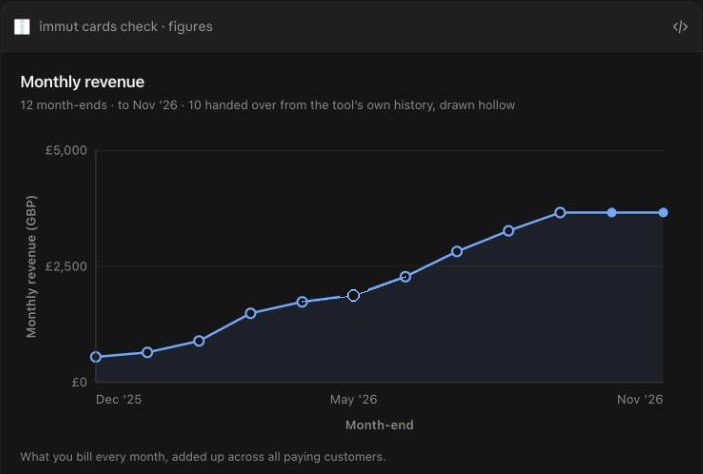
Seed B2B SaaS investors ask about retention, burn and pipeline, then ask again six weeks later. immut answers from your billing, your pipeline and your accounts, inside their own AI, without you writing another update.
immut is a Mac app that answers from the tools you already run, your billing and pipeline included. An investor you have chosen asks in their own AI whenever they want. It is agent friendly: their agent asks through MCP.
- You choose which investors can ask, and you can stop it at any time
- Your customers are shown as labels, never by name
Free for your first 3 investors.
Questions founders ask
Can we use the research credit if we make no profit yet?
An eligible startup with little or no income tax can elect to use the research credit against payroll tax. You make the election on Form 6765 with a return filed on time. The credit first reduces the employer's share of social security tax.
Source: IRS: Qualified small business payroll tax credit for increasing research activities
How long does it take to prepare answers to all these questions?
Most founders can draft them in a few focused days if their numbers live in their tools. Start with the questions your deck does not answer, then add proof as you go.
What if I do not have a number for a question yet?
Say so plainly, and say when you will have it. A clear gap with a date is a better answer than a guess, and investors notice guesses.
Should I send my numbers before the first meeting?
Send enough to earn the meeting, then share the detail once an investor is interested. Whatever you send, date every figure so it is clear how fresh it is.
Do US investors ask different questions from other investors?
Most questions are the same everywhere. The differences are about local rules and money, which is why this guide has notes for founders raising in the US at seed.